
SEO vs. PPC
March 5, 2026
SEO vs. PPC
For aspiring entrepreneurs planning to sell their services or products online, choosing the right strategy is usually an important first step. You’ll most often come across two three-letter acronyms that stand for strategies you’ve probably already encountered— SEO and PPC. Can’t decide which of these strategies will be better for your business? In this article, we’ll break down these two concepts and help you understand them.
What is SEO, and what is PPC?
First, let’s clarify what these terms actually mean. SEO stands for “Search Engine Optimization.” The acronym PPC stands for “Pay Per Click.” As the names suggest, SEO is a set of activities that make your website “optimal” from a search engine’s perspective, ensuring it appears in organic search results. PPC is paid advertising that bypasses SEO results; for a fee, your website will appear at the top of search results.
For a moment, imagine that your website is a brick-and-mortar store. If this store is located on a busy street where many people pass by every day, your offerings will be easily visible, and you’ll likely attract a relatively large number of visitors. That’s like ranking on the first page of search results. If your store is located on a side street, the number of visitors will certainly be lower than on the main street. That’s like ranking on the second or third page of search results. However, if your store is located on the outskirts of town, where people don’t usually go, that’s like ranking on the fourth page or beyond in search results. If potential customers can’t find you, they won’t shop with you. So, by using SEO and PPC, you improve your visibility so that customers can find you more easily.
What do SEO and PPC have in common?
Essentially, SEO and PPC should help you achieve the same result—bringing visitors to your website who will convert (for example, by purchasing goods or services).
When using both of these strategies, you’ll also need the same thing to start with: keyword analysis. By this term, we mean a set of relevant words and phrases that people could use to find your products or services through a search engine. A well-prepared keyword analysis is a very important part of both of these strategies, and without it, both SEO and PPC are essentially shooting in the dark.
What is the difference between SEO and PPC?
As mentioned above, SEO is a way to increase organic traffic to your website by optimizing your web pages and consistently adding high-quality content. PPC is a form of advertising where you pay to have your website or products appear in search results.
SEO is a marathon
SEO is most often used to build a website’s long-term ranking not only in search engine results but also to help raise customer awareness of your brand and increase your credibility. Results from SEO activities usually take some time to materialize but tend to have a long-lasting effect.
To get a better idea, let's take a look at what SEO actually entails. When it comes to your website's SEO settings, it's important to consider two aspects, which we call on-page and off-page:
On-Page SEO
On-page SEO refers to what is found and configured directly on the website, primarily in terms of content and technical aspects. On the content side, it involves creating high-quality, valuable content that captures people’s attention and keeps them coming back to your website—most often in the form of blog posts and videos. Technical on-page SEO settings are influenced by dozens of different parameters, such as proper page code and page load speed. This is precisely why the expertise of an SEO specialist who focuses on on-page SEO settings is so important.
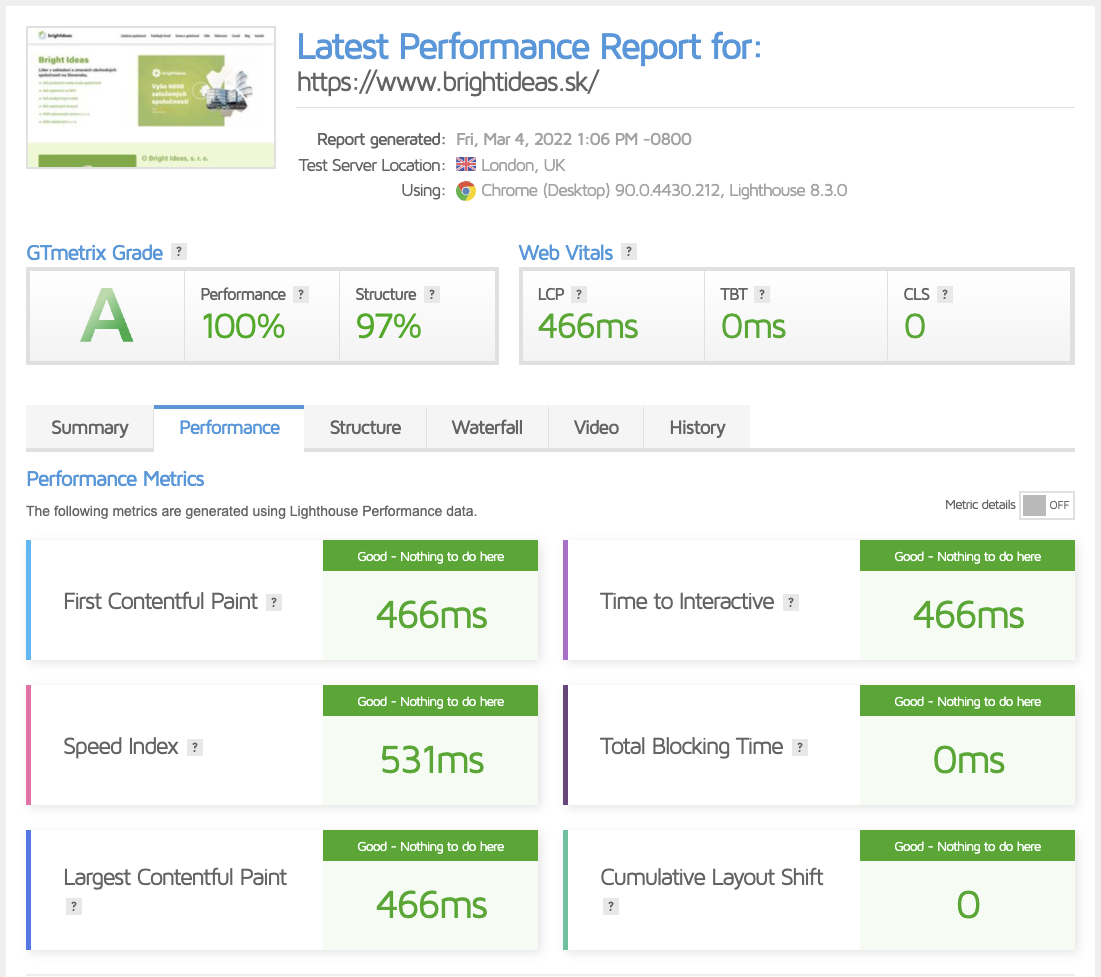
Page load speed for Bright Ideas, including detailed technical specifications:
Off-page SEO
Off-page refers to activities that take place outside of a website. A classic example of off-page SEO is social media activity that drives visitors to your website. You may also have come across the term “backlink building,” or “link building,” which involves placing links to your website on high-quality, thematically similar websites, such as yours. However, off-page SEO encompasses virtually any external factor that can influence your website’s ranking.
SEO settings involve keyword analysis, which is used to incorporate the most frequently searched terms related to a given topic into the website's content in order to improve its search engine ranking.
PPC is a sprint
PPC is a method of displaying ads on the Internet in which the advertiser pays only when a customer clicks on a given ad, rather than for the ad being displayed. The advantage is that the ad is shown only to those who are actually searching for that service or product using search engines, as well as the immediate results that PPC delivers. Results from PP activities usually come almost immediately after they are launched.
In practice, PPC means that a campaign is created based on selected keywords or phrases (which correspond to your products or services as identified in the keyword analysis), through which a link to your website is displayed in the search results. You set the budget you want to invest in the campaign, and you pay for each click on the displayed results. Each word and phrase has a different value depending on its competitiveness—the more competition there is, the higher the cost per click tends to be. The campaign ends after a certain period or once the budget is exhausted.
However, PPC does not guarantee a paying customer, but rather a website visitor. It then comes down to your strategy and skill in turning that visitor into a paying customer.
Should I Choose SEO or PPC?
When choosing between SEO and PPC, you should focus on the key differences between them.
SEO generally helps improve awareness of your brand and can help you associate your brand with a specific product or service in the eyes of customers. In the long term, it helps build credibility, which increases sales. SEO also boosts organic website traffic and contributes to long-term sustainability without the need to constantly pay for campaigns that drive visitors to your site. The advantage is that, thanks to SEO, you no longer have to pay for visitors coming through organic search. SEO activities are ideal for distributing content aimed at explaining something to website visitors or educating them.
PPC offers the advantage of highly precise targeting of specific audiences, as well as the speed with which you can launch campaigns and see results. The ability to test different types of campaigns and the overall flexibility that PPC provides help you respond more effectively to changes in the market. You also have precise control over the budget you invest in your campaigns, allowing you to better analyze the costs and profits resulting from your PPC campaigns. PPC is well-suited for the direct sale of your services and products.
So if you want to see results immediately, PPC is the better choice. However, if you want to build your brand and your plans are long-term, SEO is the better choice. Neither strategy, however, can be considered better or worse than the other. Both have their own characteristics, advantages, and disadvantages. In general, it can be said that for a business to be successful, it must focus on both short-term and long-term goals. Therefore, it seems most advantageous to use a combination of both strategies to your advantage and to devote attention to both on an ongoing basis.
High-quality SEO requires an investment of time, while PPC requires an investment of money. However, if you’re not familiar with these strategies, you could easily end up wasting both time and money. In such cases, a digital agency that has been specializing in both strategies for a long time and has ample experience with them can help you. You can then focus primarily on growing your business.

